AI Max for Search: New Google Ads Era (2026)
AI Max for Search brings Google AI into Search campaigns. See how it works, real 2026 performance data, setup steps, and when to use it.
Google Ads is shifting from strict keyword syntax to pure intent matching — and AI Max for Search is the feature leading that change. If you run Search campaigns, this is the most important update since broad match keywords. This guide explains exactly what AI Max is, how it works, the real 2026 performance data (not just Google's headline numbers), how to set it up safely, and when it actually makes sense to turn it on.
What Is AI Max for Search?
AI Max for Search is a one-click feature suite that layers Google AI on top of your existing Search campaigns — it is not a new campaign type. You enable it inside a campaign you already run, and it loosens keyword boundaries to capture relevant queries you weren't reaching before, while keeping you inside the Search channel and your own campaign structure.
When you turn it on, three core features activate (all on by default):
Search term matching — Google expands beyond your keywords using broad-match-style intent modeling plus "keywordless" technology, learning from your keywords, creative assets, and landing pages to surface more relevant queries.
Text customization (formerly automatically created assets) — generative AI creates new headlines and descriptions based on your landing page, existing ads, and keywords.
Final URL expansion (FUE) — automatically routes users to the most relevant page on your site based on search intent, similar to how Dynamic Search Ads work.
Think of it as a control spectrum: Standard Search sits on the most-control end, Performance Max on the most-automation end, and AI Max for Search lands in the middle — more reach than standard Search, more transparency and control than Performance Max.
Why AI Max Matters Right Now
This isn't a "someday" decision. Google is officially retiring Dynamic Search Ads and migrating the technology into AI Max. Here is the timeline every advertiser should have on their calendar:
September 2026 — Campaigns using Automatically Created Assets (ACA) and the campaign-level broad match setting begin auto-upgrading to AI Max.
January 2027 — New Dynamic Search Ad creation ends in Google Ads, Editor, and the API.
February 2027 — Remaining Dynamic Search Ads auto-migrate to AI Max.
In short: if you use DSA, ACA, or campaign-level broad match, you are moving to AI Max whether you plan for it or not. The smart move is to test on your own terms before the automatic switch happens.
How AI Max for Search Works
Search Term Matching
Instead of waiting for an exact keyword to fire, AI Max uses contextual, behavioral, and semantic signals to decide when and to whom your ad should show. Its AI learns from both keyword and keywordless matches, plus your creative and URLs, to find new high-intent searches. Priority in the auction works the same way it already does in Search and Performance Max.
Asset Optimization (Text Customization)
Under the "asset optimization" panel, text customization generates fresh headlines and descriptions tuned to emerging intent in real time. This is Google's rebrand of automatically created assets — now with clearer calls-to-action and sharper selling points, especially when paired with final URL expansion.
Final URL Expansion
FUE substitutes your provided URLs with dynamic landing pages that better match the query. Important: it requires text customization to be enabled, and if you use tracking templates, verify them first — misconfigured templates can produce broken 404 landing pages.
AI Max vs Performance Max: What's the Difference?
This is the single most common point of confusion, and getting it wrong leads to bad campaign structure.
AI Max for SearchPerformance MaxWhat it isA feature suite inside Search campaignsA separate, standalone campaign typeChannelsGoogle Search onlyAll channels: Search, YouTube, Display, Discover, Gmail, MapsControlKeeps your Search structure, negatives, and reportingLargely automated black boxTransparencySearch terms report with headlines & URLsMore limited reportingBest forStrong Search campaigns that have plateauedCross-channel, asset-driven growth
Bottom line: AI Max is not the same as broad match and not the same as Performance Max. It is broad-match-style intent modeling plus landing-page signals plus text customization — broader than broad match alone, but far more controllable than PMax.
The Real Performance Data (2026)
Here's where you need both sides of the story.
Google's official claims:
Advertisers activating AI Max typically see 14% more conversions or conversion value at a similar CPA/ROAS.
For campaigns still mostly using exact and phrase keywords, the uplift is reported at up to 27%.
Using the full feature suite reportedly adds 7% more versus search term matching alone. (Google internal data, 2026, non-retail advertisers.)
What independent testing shows:
A LinkedIn poll of PPC professionals found only about 16% reported good performance, while 84% reported neutral or negative results.
One agency study across ~250 ecommerce campaigns found +13% revenue but +16% higher CPA, with ROAS ranging from +42% to −35% — a wide outcome distribution.
Real-world tests warn about Search Partner Network (SPN) traffic, which can convert dramatically worse than Google.com search in some accounts.
The honest takeaway: AI Max can deliver real incremental wins, but results vary heavily by account, vertical, and budget. There is no universal "correct" setting — only what your own data proves. Google notably excludes retail from its 14% benchmark, which tells you something about where it works best.
Who Should Use AI Max for Search?
AI Max tends to win when:
Your campaigns are exact/phrase match-heavy with untapped query volume (this is the scenario behind the 27% claim).
You have strong Search campaigns that have plateaued and want incremental reach with guardrails still in place.
You have sufficient budget and conversion signal — a healthy daily budget (commonly cited around 15× target CPA) and meaningful monthly conversions produce more stable results than a hobbled minimum-budget setup.
Be more cautious if:
You operate in a regulated industry or need tight brand/intent control.
Your landing page or feed is weak — query expansion sends more varied traffic, and if the page doesn't convert it, you simply pay more.
You already run broad match, DSA, and PMax heavily — the incremental benefit is smallest here.
How to Set Up AI Max for Search (Step by Step)
The cleanest approach is to upgrade an existing, data-rich campaign rather than building from scratch.
Open Google Ads and go to your Campaigns section.
Select an existing Search campaign with at least a few months of conversion data.
Open campaign settings and scroll to the AI Max for Search option.
Start with search term matching only for your first test — don't enable text customization and final URL expansion simultaneously, so you can isolate what drives results.
If you use tracking templates, verify a dynamic landing page works before enabling final URL expansion.
Set up your controls: brand inclusions/exclusions, URL inclusions/exclusions, location of interest targeting, and text guidelines.
Exclude the Search Partner Network as a default if your data shows poor SPN conversion rates.
Run it as a campaign experiment (50/50 split) using your best campaign as the control, for a minimum of four weeks plus a ~2-week learning period.
Monitor search terms constantly and maintain tight negative keyword hygiene — this is your primary lever for controlling expansion.
AI Max Controls You Should Know
One of the biggest improvements over Performance Max is granular control. AI Max gives you:
Brand settings — specify which brands your ads should (or shouldn't) appear alongside.
URL inclusions and exclusions — control which pages can be used as landing pages.
Location of interest targeting — target by geographic intent at the ad group level.
Text guidelines — term exclusions (up to 25, max 30 characters each) and messaging restrictions (up to 40 freeform instructions, 300 characters each).
Asset removals — remove any generated asset you don't want.
Improved reporting — the search terms report now shows headlines and URLs, and asset reports measure against spend and conversions, not just impressions.
Common Pitfalls to Avoid
Letting SPN run unchecked — segment performance by network from day one.
Enabling every feature at once on day one — you'll never know what worked.
Ignoring negative keywords — query expansion without negative hygiene inflates wasted spend fast.
Broken landing pages from tracking templates — test FUE before going live.
Measuring yourself against Google's best-case study — beating the average advertiser is a realistic, valuable goal; matching a cherry-picked 200%+ case study is not.
The Bottom Line
AI Max for Search represents a genuine strategic shift — from manual keyword maintenance toward scalable, intent-driven, AI-powered Search advertising. With Dynamic Search Ads being retired into AI Max through 2026–2027, every serious advertiser needs a transition plan now rather than later.
The winning strategy isn't to resist AI Max or flip it on everywhere. It's to test methodically, control it tightly, and scale only what delivers measurable, incremental results for your specific account. Used well — strong campaigns, healthy budget, clean landing pages, active monitoring — it can unlock query volume you simply couldn't reach with keywords alone.
Need help making the transition? At Feo Digital, we run controlled AI Max experiments, manage the migration from Dynamic Search Ads, and optimize your Google Ads campaigns for real, incremental ROI.
Frequently Asked Questions
Is AI Max a new campaign type?
No. AI Max for Search is a feature suite you enable inside existing Search campaigns. Performance Max is the separate, all-channel campaign type.
Is AI Max the same as broad match?
No, but they're related. AI Max uses broad-match-style intent modeling combined with landing-page signals and text customization, making it broader than broad match alone.
Will my Dynamic Search Ads become AI Max automatically?
Yes. New DSA creation ends in January 2027, and remaining DSAs auto-migrate to AI Max starting February 2027. Campaigns using Automatically Created Assets and campaign-level broad match begin auto-upgrading in September 2026.
How much does AI Max improve performance?
Google reports an average of about 14% more conversions or conversion value (up to 27% for exact/phrase-heavy campaigns). However, independent testing shows highly variable results, with many advertisers seeing neutral or negative outcomes. Results depend heavily on account, vertical, and budget.
Related Articles
How to Reduce Wasted Ad Spend and Improve ROAS in 2026
Smart campaign structures and proper conversion tracking are the keys to getting more value from every advertising dollar you spend.
By Feo Digital Editorial Team
Read Article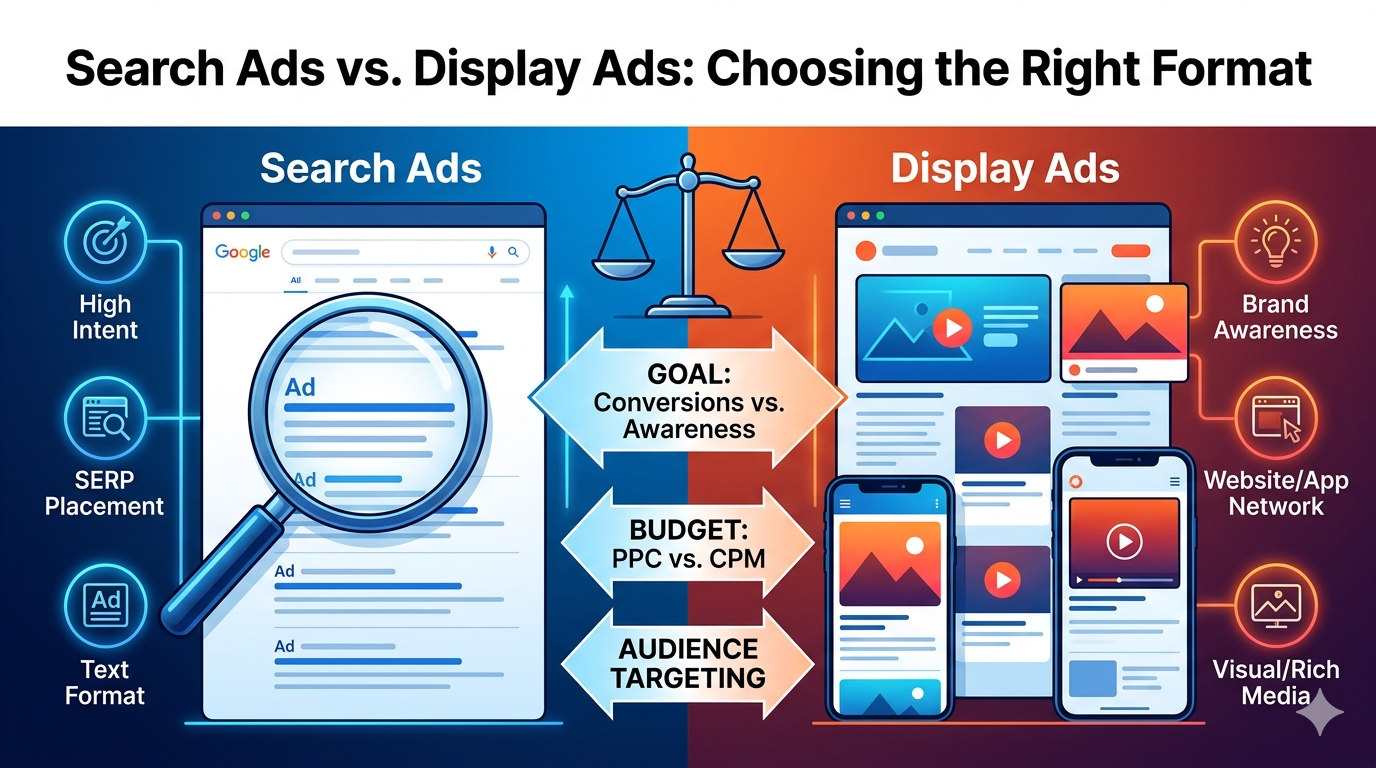
Search Ads vs. Display Ads: Choosing the Right Format
Learn the strengths of each Google Ads format and when to use them for maximum impact, conversions, and return on investment.
By Feo Digital Editorial Team
Read ArticleNeed Help Implementing This?
Our team can help you put these strategies into action. Get a free consultation to discuss your specific needs.
Get a Free Consultation