How to Build a Full-Funnel Digital Marketing Strategy
Most businesses pour resources into one channel. Real growth happens when you connect all your channels into a unified strategy that covers every stage of the buyer journey.

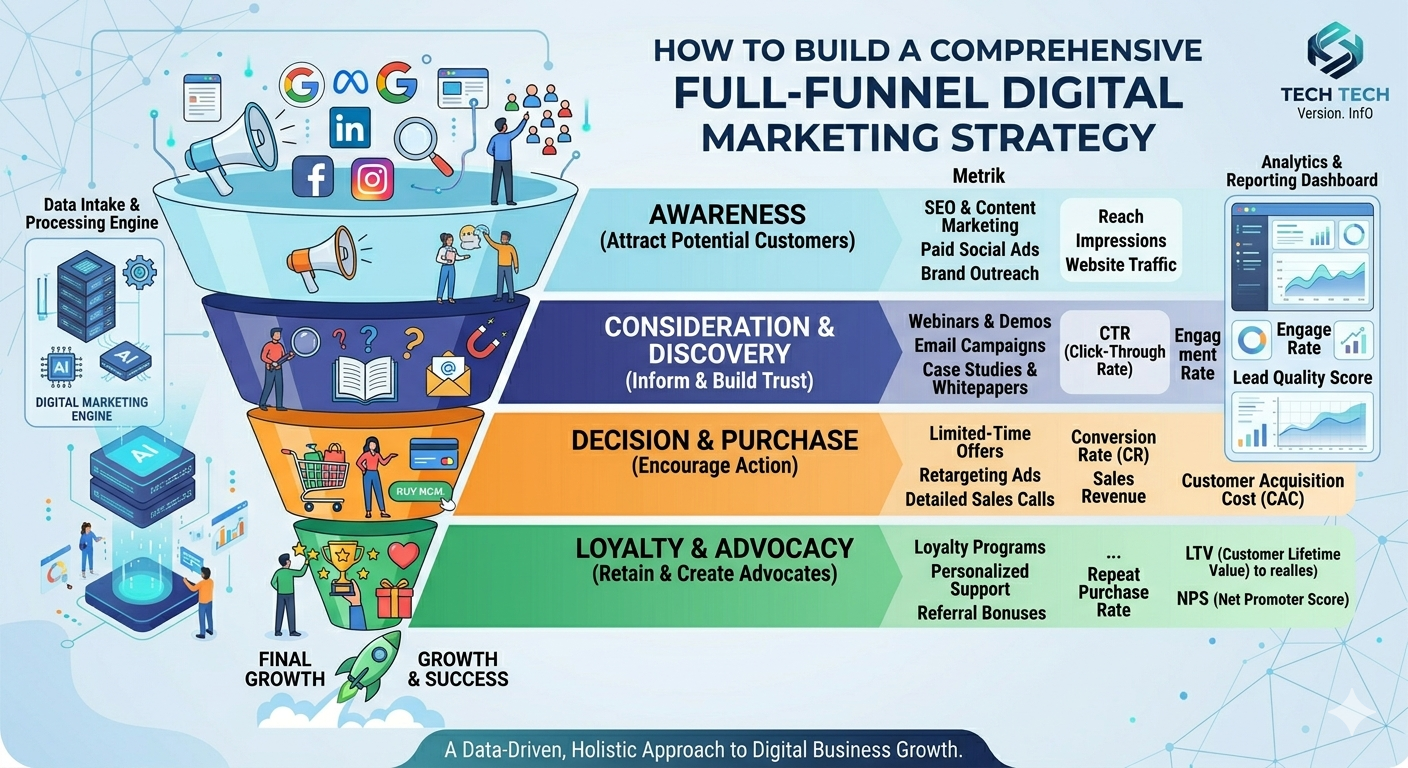
Too many businesses make the mistake of investing heavily in a single marketing channel while ignoring the rest. A brand that focuses solely on Google Ads skips the awareness stage and becomes dependent on a narrow pool of ready-to-buy prospects. A brand that focuses only on SEO misses conversion opportunities at the bottom of the funnel. True digital growth comes from building a full-funnel strategy that guides prospects from awareness through consideration to conversion.
Understanding the Digital Marketing Funnel
The marketing funnel has three core stages: Top of Funnel (awareness), Middle of Funnel (consideration), and Bottom of Funnel (conversion). Each stage demands different tactics, different messaging, and different success metrics. At Feo Digital, we plan each stage independently for our clients but integrate them so they work as a connected system.
Top of Funnel: The Awareness Stage
At this stage, the goal is to introduce your brand to potential customers who do not yet know you exist. Content marketing (blog posts, guides), social media posts, video content, and display advertising all play a role here. Providing value without asking for anything in return is the first step in building trust. Organic discovery through SEO is the most cost-effective way to generate awareness at scale.
Middle of Funnel: The Consideration Stage
Once users have engaged with your brand, you need to guide them toward the next step. Case studies, client testimonials, comparison content, and detailed service pages are highly effective at this stage. Use email nurture sequences to keep interested prospects informed and engaged. Deploy remarketing campaigns to re-capture users who visited your site but left without converting. Building trust and demonstrating expertise is critical here.
Bottom of Funnel: The Conversion Stage
For prospects who are ready to buy, deploy high-intent search ads, landing pages with clear CTAs, and direct response campaigns. Minimizing friction at this stage is essential — reduce form fields, offer multiple contact options, and include trust signals like testimonials, certifications, and guarantees. Make the path from interest to action as short and smooth as possible.
Connecting the Channels Together
The power of a full-funnel strategy lies in how the channels feed each other. Your blog content attracts organic traffic (top of funnel), those visitors get added to remarketing audiences (middle of funnel), and then search ads convert them when they are ready to take action (bottom of funnel). Each channel reinforces the others, and when they work together, results compound exponentially.
Conclusion: Waste No Opportunity
A full-funnel strategy ensures no opportunity slips through the cracks. By connecting your channels and aligning your messaging to each stage of the buyer journey, you build a marketing system that compounds over time. This approach requires patience, but it is the most sustainable and profitable growth model in the long run.
Frequently Asked Questions
What is a full-funnel digital marketing strategy?
A full-funnel strategy addresses every stage of the customer journey — from initial awareness (top of funnel), through consideration and evaluation (middle of funnel), to final conversion (bottom of funnel). It uses different channels and messaging for each stage to systematically guide prospects toward becoming customers.
What channels work best for top-of-funnel marketing?
Content marketing, SEO, social media, display advertising, and video marketing are the most effective for building awareness. The goal at this stage is to reach new audiences and provide value — not to sell directly. Blog posts, educational videos, and social content help introduce your brand to potential customers organically.
How do you measure the success of a full-funnel strategy?
Each funnel stage has its own KPIs. Top of funnel: impressions, reach, and website traffic. Middle of funnel: engagement rate, email signups, and content downloads. Bottom of funnel: conversion rate, cost per acquisition, and revenue. Tracking these metrics together reveals how effectively your funnel moves prospects toward purchase.
Why do most businesses fail at full-funnel marketing?
Most businesses over-invest in bottom-of-funnel tactics (like search ads) while neglecting the awareness and consideration stages. This creates a narrow pipeline dependent on a small pool of ready-to-buy prospects. A balanced approach builds a larger audience that converts more consistently over time.
How long does it take to see results from a full-funnel strategy?
Bottom-of-funnel tactics like search ads can show results within weeks. Middle-of-funnel nurturing typically takes 1–3 months to build momentum. Top-of-funnel brand building requires 3–6 months for meaningful impact. A fully integrated funnel usually begins showing compounding returns after 6–12 months of consistent execution.
Need Help Implementing This?
Our team can help you put these strategies into action. Get a free consultation to discuss your specific needs.
Get a Free Consultation